

Seattle Aquarium

 A doorway to another world, another place, another time.
 No hiking today. We pack up camp after breakfast. We walk to the river to retire our walking sticks gathered two days prior. We ceremoniously throw them into the rapids from the footbridge.
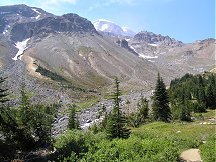 The wife, the child, and I hike from White River campground to Glacier Basin. The view of The Mountain from this basin is spectacular: forest, meadow, river, rock, basalt cliffs, sun, puffs of clouds that assemble and spin and quickly dissipate. We thank God for being here to see this because we almost didn't make it.
 Tonight, the child, the wife, and I are retiring to our sleeping bags in our three-man tent in our campsite of White River Campground of Mount Rainier National Park. The fire has just been extinguished and the sky is filled with thousands of visible stars, most of which cannot be seen from our home due to the lights of suburban and urban living that washout the night sky. Our bellies are full of hotdogs and baked beans. This meal was chosen by the child, who in her toddler mind, thought this would be good food for the evening. It was.
 "I saw in [the] eyes [of neighbors who came to visit] something I was to see over and over in every part of the nation—a burning desire to go, to move, to get under way, anyplace, away from any Here."
The article by Ted Conover, "Capitalist Roaders," captures some of the excitement of a culture that is just beginning to really discover individual ownership of automobiles. There is a new middle class emerging in China that is changing the way that China views itself. Subsequently, freeways and highways are being built across China to ensure the growth of car ownership and ease, for some, of moving about the country. Conover traveled with members of the Beijing Target Auto Club as they drove a circuitous route from Beijing to Hubei Province and back, with stops at the recently completed Three Gorges Dam on the Yangtze River and Shennongjia, an UNESCO biosphere reserve. Most of their journey, however, is spent in their cars, on the roads, oftentimes for twelve or more hours each day.
Conover captures some of the thrill and excitement of a burgeoning car culture, while pondering what that culture will look like in the near future. China will soon have the most miles of roads for a single nation, second only to the United States, and then will quickly surpass even that number. China's need for petroleum to fuel the cars, as well as for the asphalt, will speed up the depletion of global oil resources, and has already dramatically increased air pollution. There is also the question of how the world's largest communist country will embrace the capitalism that underlies the car culture. McDonald's is already in partnership with China's state-run petroleum giant Sinopec. The plan is to build filling stations that include drive-thru McDonald's restaurants along major highways and freeways. Will China's road system soon resemble that of the United States?
The question of what the United States road system looks like, and how it influences other aspects of our culture and our lives is examined in the article by Robert Sullivan. In the first of four examinations, he looks at the automobile infrastructure of New England. As he states in his opening paragraph: "The roads—and the routes and the paths, the trails and the rights-of-way—take us away and they bring us home. They make us who we are and they make the places where we live."
These two sentences are at the heart of what Ted Conover is expressing about China's new car culture and its auto clubs; are what Robert Sullivan's explorations are based upon; are what John Steinbeck was attempting to discover in his travels with Charley; and are the flavor of Joan Ockman's beautiful prose poem about wandering about in her car.
What intrigues me, in addition to the consistent flavor that runs through all three of the articles and Steinbeck's book, is Sullivan's conversations with people whose professions are to think about driving and its effects upon us. He talks with both Dolores Hayden, a professor of architecture and author of the book A Field Guide to Sprawl, and with Andy Wiley-Schwartz, vice-president for transportation of Project for Public Places. Their conversations with Sullivan help to really solidify his argument that roads "make us who we are and they make the places where we live."
While reading the Sullivan article, the myriad of images already in my mind from Ockman's piece, the Conover article, and Steinbeck's book, as well as the photographs that accompany the Sullivan article, collided with one another to create some huge "accident" or "traffic jam" in my mind. My thoughts kept slowing down like traffic in New York City or Beijing or Seattle, which was not necessarily a bad thing, since it allowed for more intense focus and reflection upon what car culture means for me, and for you. One of Matthew Monteith's photographs is of the side of a McDonald's restaurant with the prevalent image of a Big Mac and the words "Super Size It!" The caption below the photograph reads "McDonald's, I-95, Connecticut." But, it could easily read "McDonald's drive-thru at Sinopec gasoline station, Chinese Freeway, Hubei Province."
What will our cars make us? What will they make the places where we live? Will they help us to rediscover who we are? As Steinbeck laments before he sets off on his journey across the United States: "I had not heard the speech of America, smelled the grass and trees and sewage, seen its hills and water, its color and quality of light. I knew the changes only from books and newspapers." Steinbeck did get out of his car, though, in order to hear and smell and see; I have just been reading books, magazines, and newspapers. Perhaps I need to go for a drive.
---
I also find it interesting that Robert Sullivan's article in Dwell is sponsored and underwritten by Saturn. Why is a car company supporting an article on how cars affect our lives? As the Dwell introduction to the article proclaims: "With the generous support of Saturn, who shares our mobile fascination..."
So, I figured that this post should also be sponsored by a car, although without the knowledge of the car's maker. If Dwell undergirds its article with a relationship to a particular brand of automobile, then surely I can express my own bias toward the Smart car, which is coming soon to the United States. See what Europeans have been enjoying for the past few years at www.smartusa.com.
Economical. Environmentally friendly. Safe. SMART.
 The child and I wandered around a bookstore this evening. It was fun to watch her as she bounced from book to book, aisle to aisle, giggling and chattering.
 "These are not joyful times. These are challenging times. These are difficult times."