Showing posts with label perspectives. Show all posts

Wednesday, June 20, 2018

RILKEAN HOARE


Detail of "Eider Duck," plate 246 of Birds of America, published 1827–1838, by John James Audubon.

---

"Perhaps it is those eyes. Yes, it's those eyes. It always is. They take in the whole of the world, even as they ignore it."

—page 39, RISINGTIDEFALLINGSTAR by Philip Hoare

---

"Animals see the open with their whole eyes."

"Or maybe an animal, incapable of speech, lifts its head / and quietly sees right through us."

—from "The Eighth Elegy" by Rainer Maria Rilke, as translated by Gary Miranda

Saturday, January 16, 2016

FAUXLIAGE

The Child and TWT headed off to Tacoma for an afternoon of viewing fauxliage.

---


Our first stop was at Tinkertopia to view their window display, which featured The Seedling Collection by Cher Nalty. The various miniature cacti and succulents are "planted" in small terra cotta pots, but their fauxliage is crocheted by the artist. The attention to detail and resemblance of the actual plants they are modeled upon was fascinating.

---

Our next stop was to the W. W. Seymour Botanical Conservatory in Tacoma's Wright Park to visit their exhibit Evolution: Art, Science & Adaptation. My favorite pieces were those that became one with their surroundings, rather than those which seemed a bit dissonant.


Cactopi by Ed Kroupa. I especially loved this piece, but it was more than it simply mimicking an octopus, albeit in a cactus form. First, I didn't even notice it, since it blended in with the real cacti and succulents that were behind and next to it; The Child had to point it out to me. Second, I love that it played on the octopus's ability to camouflage itself. This fauxliage was as powerful as The Seedling Collection.


Green by Yuki Nakamura. As with the Cactopi, these porcelain casts of antique and current lightbulb forms blend into the natural foliage in which these nest. This fauxliage mimicked fungi forms, and the white and green coloring helped them to feel part of landscape. I did find these forms on my own, and they "feel" as though they belong in this setting.

Thursday, December 23, 2010

"INDUSTRIAL" ZOOLIGHTS


To make Point Defiance Zoo & Aquarium's Zoolights fresh for me, I needed to look at the lights with "new" eyes. I found beauty in the the simple and the geometric.

Friday, November 26, 2010

BLACK FRIDAY BLACKOUT


Today is Black Friday. I will be staying home as part of Buy Nothing Day.

Tomorrow is Small Business Saturday. I will be supporting local small businesses with my presence and holiday dollars.

---

Support your local independent bookseller. Locate yours at IndieBound.

---

The font pictured above is Blackout. You can find it at the website of The League of Movable Type, a collection of open source fonts.

Wednesday, September 22, 2010

FAMILIAR LANDSCAPES


The neighbor's house is being demolished, two-and-one-half years after her death. Her son also decided to remove most of the large trees in her yard. The large fir that once sat in the middle of her front yard—like our own black walnut tree or the other neighbor's monkey tree, each situated right in the middle of our front yards—is coming down.

The sky opened up as limbs disappeared. More sky appeared as the trunk diminished. Houses we haven't been able to see from our yard or front window are now visible. Street lights a block over now shine their weak light upon our street at night.

Something so familiar—the neighbor's yard, her home, conversations with her in her living room—have all changed. Some things have died or disappeared. Others have been reframed, refreshed, renewed.

Friday, November 09, 2007

PROTEST


The child and I visited the Tacoma Art Museum on Friday afternoon. A protest against a planned detention center in the Tacoma tideflats was in progress. The protest appeared to be peaceful, although that didn't stop the Tacoma police department from setting up their battle lines.


There were officers in patrol cars, on motorcycles, on bicycles, on foot, and in riot gear. It seemed that the number of officers may have dwarfed that of the protesters.


The protest grew in size, however, and began to move from its initial location in the park next to the Tacoma Convention Center. Soon, the protestors had partially succeeded in their goal of "shutting down" the city. They effectively blocked the Tacoma Link light rail from running, whereupon the "city" shut down its operation for the day's foreseeable future. The child and I were able to grab the last Link back to where we had parked across town before it was sent "out of service." They—and the police officers in an attempt to confine the protestors to an area under police control and surveillance—also succeeded in shutting down a number of streets, which snarled traffic in the downtown core.

Monday, April 30, 2007

PAIN

The rich associate poverty with a particular form of pain called hunger...I assert that poor people are not necessarily hungry. That is why in this ugly little list of poverty-phenomena I omit hunger for the more general if awkward term pain.

—page 139, Poor People by William T. Vollmann

The child and I went and helped out this evening at our local "soup kitchen." The group from my church that served provided tacos with all of the fixin's; fresh fruit in the form of bananas, apples, and oranges; poppyseed muffins; milk; and juice. We served about fifty of the area's homeless and/or hungry.

The reason we did this was two-fold. First, I want to expose the child to all kinds of people and all kinds of experiences. Second, I felt compelled to help. All too often my vision is directed inward. And, I used to go down and help with this meal program in the past and really enjoyed being around the cast of characters that comes to eat.

When we arrived, the woman in charge of the program told me that the child could not help because she was too young. That was not going to stop us, however. I had informed the child that she would be able to help and I made sure that it did indeed happen. I was assigned to the end of the line pouring milk and juice. I then placed the child in charge of handing me cups to fill. The child also insisted on holding the bottoms of the gallon containers as I poured. The child was content and happy with her simple tasks.

Once the woman in charge saw that the child was not "in the way" or handling food, she realized that there were things that she could do. So, next thing I know, the child and I are walking amongst the tables where people are eating, handing out malt chocolate Easter eggs. The child would say, "Would you like some candy?" Her more-than-usual shyness and toddler smile broke the ice with most of the people, and even if they declined the candy they shook her hand or said "No, thank you," to which the child replied, "Yourwelcome," as though it were one word.

When everyone who came to eat was having second helpings, our crew began to eat. They all stood behind the serving tables with their tacos. The child and I decided to go sit with some of the people we had served, partly in order that the child could sit in a chair, and partly for me to step out of my introverted comfort-zone.

We sat across from self-proclaimed "Crazy" Bob. We awkwardly carried on small talk about the day, the weather, and the child, until he made brief mention of his work. I asked him what he did for a living. He works as a receiver in a warehouse. Once he started talking about his job, his face began to glow with the obvious pride he takes in his work. I was able to share my past work experience as a receiving manager, and "Crazy" Bob and I talked for ten or fifteen minutes about work and life while we ate. After we were both done—and we were the last two eating, me due to general slowness in eating, he because he was on his third helping because he "needed the calories for his work, since this would probably be his only meal until dinner tomorrow"—we shook hands, said goodbye to one another, and went our separate ways.

His hands, like most of those that the child and I gave milk and juice and candy to, were colored with dirt and weathered with work and exposure to the elements. They were hands that tell a story. Hands that tell a story of pain, but also of pride. Hands that tell a story of drug or alcohol abuse, but also of a willingness to keep going forward. Hands that would reach out and shake the hands of a stranger, even if it was me.

Saturday, March 10, 2007

PATTERNS


I like geometry. I like symmetry. I like pattern. I like order. I like these various brickworks from building walls in Puyallup.

Tuesday, October 17, 2006

GOD'S DREAMS

You turn us back to dust, and say, "Turn back, you mortals." For a thousand years in your sight are like yesterday when it is past, or like a watch in the night. You sweep them away; they are like a dream, like grass that is renewed in the morning; in the morning it flourishes and is renewed; in the evening it fades and withers.
—Psalm 90:3-6

We are like dreams, indeed.

The days are difficult. The family battles ills and sickness. I am fatigued.

North Korea plays with things it should not. We consider things we should not.

I am writing, though. I have been furiously working on some "assignments," which are keeping me busy between working and caring for the child. I haven't written like this in some time. It feels good. Slowly, the discipline returns. Now, I just need some more time to read and recharge. I need some time to dream.

Tuesday, August 29, 2006

MOUNTAIN TIME

No hiking today. We pack up camp after breakfast. We walk to the river to retire our walking sticks gathered two days prior. We ceremoniously throw them into the rapids from the footbridge.

The plan is to drive from White River to Ohanapecosh, to see what that campground has to offer, and to return home. The plan changes when we encounter road construction near Panther Creek. We decide, after twenty-five minutes of combined waiting at three separate sites of construction within two miles, to travel home by going around The Mountain. The map shows that it is the same distance and then we don't have to encounter the same road construction. Our day turns into an auto tour of The Mountain. We make brief stops at Ohanapecosh, Paradise, Longmire. We stop at Cougar Rock for lunch. The child vomits her lunch all over herself as we pass through the Nisqually Entrance gate, so we stop to change her clothes. We pull over in Elbe so that the child can see some of the locomotives near the Mount Rainier Scenic Railroad depot. She is currently facinated by the book Freight Train by Donald Crews. We read it every night before she goes to bed. Now she gets to see the real thing.

We were glad to be able to camp and hike and enjoy the company of one another. Now, we are glad to be home and take hot showers and sleep in our own beds.

Monday, August 28, 2006

MOUNTAIN TIME

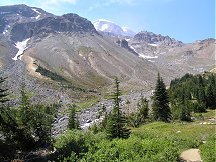
The wife, the child, and I hike from White River campground to Glacier Basin. The view of The Mountain from this basin is spectacular: forest, meadow, river, rock, basalt cliffs, sun, puffs of clouds that assemble and spin and quickly dissipate. We thank God for being here to see this because we almost didn't make it.

First, we are not hikers by nature. The wife would most likely rather not, and I engage in the activity far too infrequently. Second, the wife was battling a cold. Third, I am horribly out of shape and was carrying the child in a backpack. Fourth, sleep was fitful for all of us last night.

Last night, after gathering walking sticks from the riverbed, and then going through bedtime rituals, we all went to bed at the same time. The child was not going to sleep in a strange place—the tent—by herself. The wife and the child were sleeping in their individual sleeping bags on an air mattress, while I was sleeping in my sleeping bag in the "trench" next to it. The child is an "active" sleeper. This was compounded by any movement by the wife, which would propel the child about due to the weight difference. Therefore, the child was often propelled into the trench and onto me. At one point, the child even crawled down to curl up at my feet, whereupon I placed her back into her sleeping bag. The decision was made that the air mattress would only serve one night of duty.

Today, our slow pace, fatigue, and various aches and pains meant that our seven mile round-trip hike, with an overall ascent of 1640 feet in elevation, took much longer than a fit, less encumbered hiker could do the same. We did make it, however. Then we enjoyed our lunch and hiked back—most of it downhill—with much less effort. Overall, it was a great experience and the first hike of the child, some of which she did actually walk.

It made our dinner of steak, corn on the cob, and roasted vegetables that much better. The only thing missing was a good beer!

Tonight, the child is more comfortable with the idea of sleeping in the tent. This allows the wife and I to stay up slightly later than her to enjoy the fire and the company of one another, under the canopies of hemlocks and summer stars. We also know there is no air mattress this evening to hinder sleep.

Sunday, August 27, 2006

MOUNTAIN TIME

Tonight, the child, the wife, and I are retiring to our sleeping bags in our three-man tent in our campsite of White River Campground of Mount Rainier National Park. The fire has just been extinguished and the sky is filled with thousands of visible stars, most of which cannot be seen from our home due to the lights of suburban and urban living that washout the night sky. Our bellies are full of hotdogs and baked beans. This meal was chosen by the child, who in her toddler mind, thought this would be good food for the evening. It was.

This is the child's first camping trip. She is excited about her sleeping bag. She is excited about marshmallows toasted over hot coals. She is excited by hotdogs and baked beans. She is excited by the river whose rapids we stood inches above upon a footbridge. She is excited by all of the rocks. It is wonderful to see her interaction with nature and the world around her. Everything is new. Everything is full of potential. Nothing, or very little, has yet to be soured by those around her, or events, or her own shortcomings. This is paradise.

Monday, August 21, 2006

PERSPECTIVES

The child and I wandered around a bookstore this evening. It was fun to watch her as she bounced from book to book, aisle to aisle, giggling and chattering.

She has a great eye. There is no consistency that I can recognize to what catches her attention, but she knows what she likes. One book was liked because of its color, pink or green; another was liked because of an image on the cover, a monkey or a bunch of flowers; another due to its shape, square rather than rectangular; yet another for its size, large relative to all its neighbors. Her choices were many of the same books that caught my attention as well.

So, we wandered about without any aim, unfettered, and free to gaze at whatever peaked our interest, collectively or individually.

Monday, August 14, 2006

PERSPECTIVES

Perhaps my outlook on life is too dour. The child and I were playing in my "nostalgia box" this evening. It is filled with an assortment of clutter—old birthday cards, my high school and college graduation caps, Cub Scout arm bands and neckerchiefs, crappy poems I wrote in 1988, and various toys. The child was intrigued by the toys, and, truth be told, so was I. Pretty soon we had various tops, a gyroscope, a miniature Slinky, and a magnifying glass scattered about the kitchen floor.

We used the magnifying glass to read the print on cards and look at the faces of action figures up close. We looked at each other's distorted eyes. We had three tops zipping about the floor, a gyroscope spinning upon my fingertip, and Slinky bouncing from one hand to another. Before I realize it we are flying green, red, and yellow paper airplanes around the dining room. The child then wanted to play with her Play-Doh. To the high chair! Red Play-Doh became a baby, bowl of pancakes, and spoon with which to feed the baby. Pancakes morphed into a bottle. Blue Play-Doh became a snake, which in turn became a stack of cookies and a frog head to feed them into. Yellow Play-Doh became a locomotive and boxcars, a tunnel turned into a rainbow. Boxcars became blocks. It was silly and organic and fluid. It was fun. It was unfettered.

Three days ago, the child saw the cover of the August 03-09 issue of local "newsweekly" The Stranger lying on the floor of our home library. It featured a painting by artist Gordon Wiebe. The piece is called Possible Ghosts, which is a "tree" of assembled, mostly earth-tone "ghosts" that is raining upon the ground beneath it. When I initially saw it, I thought it somewhat depressing with a miniscule glimpse of hope hidden somewhere within. When the child saw it, she was filled with joy. Perplexed, I asked her if the faces were happy, sad, or mad. She emphatically stated, "Happy," and proceeded to point out the faces that were the most happy. They were the faces with their mouths slightly more agape than the others.

When the child has insisted that she is happy, she drops her jaw as low as possible and forms her mouth into an exaggerated oval. Her face becomes distorted as though in rictus. I find the display rather absurd and disturbing, but she insists she is "happy." Much like some of the mouths in Possible Ghosts.

Two days ago, the child accompanies me to the barber. As we are waiting for my turn to get my hair cut, we begin to rummage through the shop's magazines and books for wee ones. Much to the delight of the child, we find a magazine on gorillas. Flipping through its pages, we come upon a picture of a young gorilla displaying the same face as the child's "happy" face. The child points at it and gleefully shouts, "Happy!" The title at the top of the page informs me that these are gorilla emotions. The caption below the picture that the finger of my child rests upon informs me that this is a display of gorilla happiness.

I found a new perspective on the world, thanks to the child, through Play-Doh, "possible ghost" paintings, and gorilla faces. Now, let's see if I can make it last for a short while.

[You really need to check out some of Gordon Wiebe's other works as well. They are not depressing at all, as I first thought. In fact, they are all infused with hope, something I was unable to see, but which the child immediately recognized. Hopefully, she can keep some of that awareness and sensitivity with her as she grows!]

---

Another story:
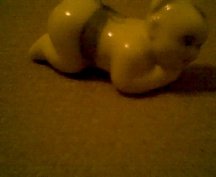
The child finds this small porcelain Chinese doll that I have, pictured above. She pulls it out of the box and announces, "Night-night. Baby. Baby, night-night." Sure enough, before me, in the child's hand, is a "baby" that is in the position that the child sleeps in: head down, arms pulled in, knees tucked under the belly, posterior pointing toward the ceiling or the night sky. It does appear that it is a baby going night-night. It is familiar to the child because it is her. A new perspective on an old item.